Muslin Clamp System — Mechanism Design¶
1. Purpose¶
The photosensitive muslin must be held taut against the film plane frame throughout exposures lasting 30–45 minutes, at any tilt angle up to ±40° and any swing angle up to ±28°. Loading and unloading happens under mixed safelight conditions, so the clamp mechanism must provide clear tactile feedback without visual confirmation.
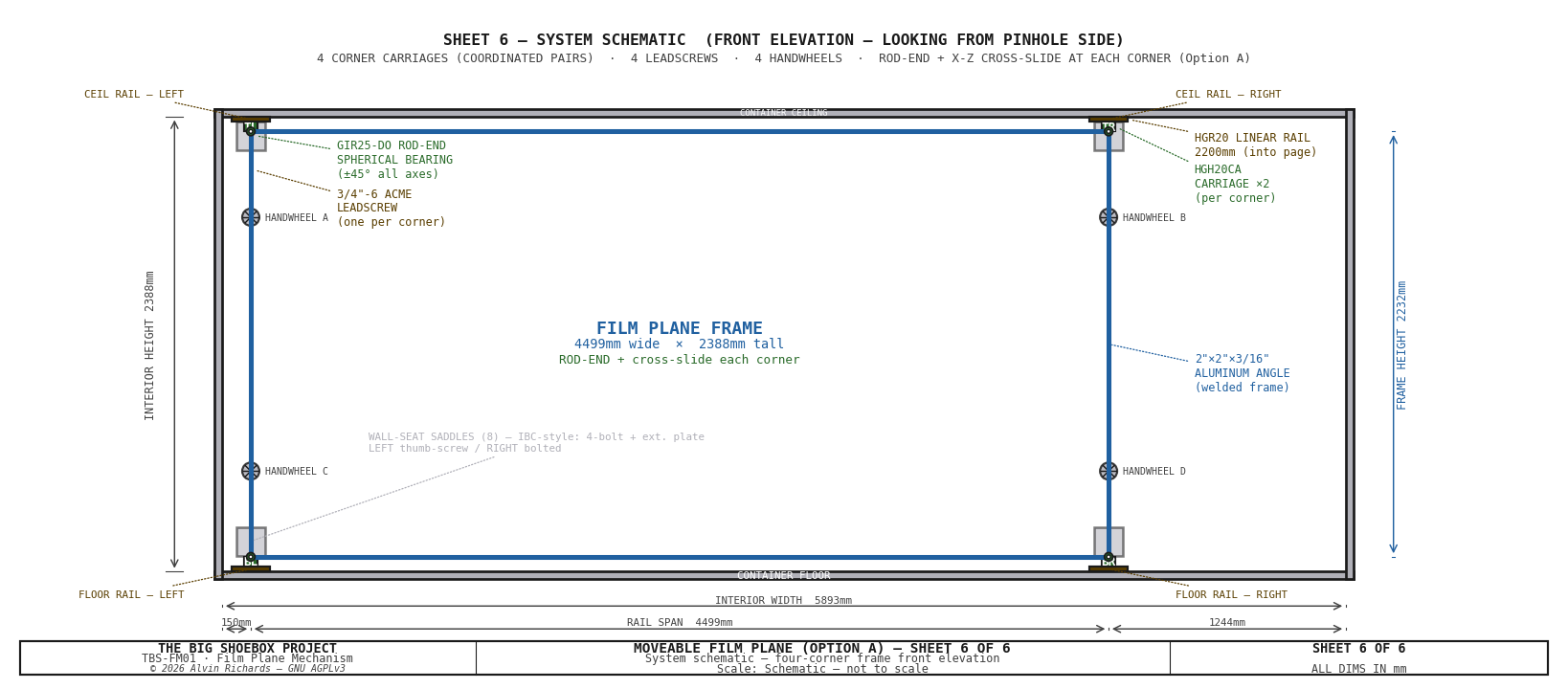
This report describes the muslin clamp system that secures the muslin to the 2"×2"×1/8" aluminum L-angle perimeter frame (the film-plane frame — Film Plane Mechanism §4). Rather than a custom mechanism, it uses off-the-shelf inert nylon spring clamps clipped over the frame edge, with an inert HDPE filler strip packing the open L channel so each clamp bites a solid full-depth edge. The angle's two 2-inch (≈51mm) legs are the flat leg (bonded behind the ACM backing board) and the upstand (standing proud toward the pinhole).
2. Clamp Layout¶
58 nylon spring clamps at 150mm centers grip the muslin on three edges of the 4,389mm × 2,094mm film-plane frame — the top and the two sides. The bottom edge is left unclamped: there is no clearance between the raised walkway deck and the board's bottom edge for a clamp body, and leaving it open keeps the swing/tilt envelope clear. The muslin is held taut by the three clamped edges.
| Edge | Length | Clamp Count |
|---|---|---|
| Top horizontal | 4,389mm | 30 |
| Left vertical | 2,094mm | 14 |
| Right vertical | 2,094mm | 14 |
| Bottom horizontal | — | 0 (walkway clearance) |
| Total | 58 |
3. Clamp Mechanism¶
Each clamp is an off-the-shelf inert nylon spring clamp (Pittsburgh 69289 — a fiberglass body with swivel pads) clipped over the frame edge. Because the clamp must open around the full 2″ angle leg to reach the muslin on the board (leg + ACM + muslin ≈ 55mm), a ≥3″ clamp is used — a 2″ clamp is too tight. An inert HDPE filler strip packs the open L channel so the clamp closes on a solid full-depth sandwich (ALU upstand + HDPE + ACM + muslin) instead of collapsing into the void.
The clamp is fiberglass/nylon, not steel — deliberately, for the cyanotype/ferricyanide splash zone where a steel spring would rust. It clips on and off by hand (squeeze the handle), giving clear tactile feedback for loading/unloading muslin under safelight, and its spring holds it closed at any tilt or swing angle. This replaces the earlier custom through-bolted bracket + torsion-spring + neoprene-jaw clip — no fabrication, and chemistry-safe.
3.1 Muslin Path¶
The muslin lies over the ACM backing board (the pinhole face) and its edge wraps the frame lip. Each clamp grips the whole frame edge as one sandwich — the muslin, the ACM, the HDPE filler, and the ALU upstand — pinning the muslin directly against the rigid ACM/filler stack. The ACM is the anvil; no separate hem wrap is needed.
3.2 HDPE Filler Strip¶
An inert HDPE strip, 44.1mm deep (= frame leg 50.8 − ACM 3 − muslin 0.5 − angle 3.2), runs continuously in the L channel along the three clamped edges (~8.7 m). It brings the open channel up to a solid full-depth edge so the clamp's swivel pads bear on solid material rather than air. HDPE is inert (chemistry-safe, the same family as the tray liner), rigid enough to back the clamp, and cut to suit — firm at fabrication.
4. Parts List¶
All items ship within the United States. Local Southern California pickup noted where available.
| Item | Spec | Qty | Supplier | Est. cost |
|---|---|---|---|---|
| Nylon spring clamp, 3½″ (Pittsburgh 69289) (69289) | Inert fiberglass/nylon spring clamp with swivel pads — no corrosion in the cyanotype splash zone (replaces the custom steel-bracket clip). Clips over the filler-filled L-frame edge to grip the muslin; the jaw must clear ~55mm (2" leg + ACM + muslin), so a ≥3" clamp. Top + 2 side edges only (bottom = walkway/swing clearance). Confirm the open-jaw ≥2" at purchase; 2½" 69290 is the smaller-body fallback. | 58 ea | Harbor Freight / Amazon | $115–$173 |
| HDPE filler strip (L-channel packer) | Inert HDPE strip, 44.125mm deep (= frame leg − ACM − muslin − angle), filling the aluminum-angle L channel along the 3 clamped edges (~8.6 m) so the nylon clamp bites a solid full-depth sandwich. Cut to suit; chemistry-safe (same family as the tray liner). Firm at fab. | 1 lot | TAP Plastics / McMaster-Carr | $30–$70 |
| Clamp total | $145–$243 |
Clamp system estimated cost: $165 to $223 (58 nylon clamps + HDPE filler strip).
5. Maintenance¶
| Interval | Task |
|---|---|
| Before each session | Inspect muslin clamp engagement — all 58 clamps clipped on the three edges |
| Monthly | Check each nylon clamp still springs firmly closed; swap out any weak or cracked clamp (inexpensive, off-the-shelf) |
| Every 6 months | Verify the clamps hold the muslin taut under gravity at 40° tilt; re-seat any that have crept |
| Annually | Inspect the HDPE filler strip for damage; wipe the clamps + filler clean of chemistry residue |
6. Source References¶
- Film Plane Mechanism Report — Parent report: four-corner independent actuation mechanism that the clamp system attaches to.
- Harbor Freight 69289 — 3½″ nylon spring clamp — inert fiberglass spring clamp with swivel pads (the muslin clamp).
- HDPE sheet — TAP Plastics — inert, chemistry-safe L-channel filler material.