Chemistry Prep Shelf
1. Purpose
Cyanotype processing requires a clean, stable work surface for:
- Mixing sensitizer chemistry (ammonium iron(III) oxalate + potassium ferricyanide)
- Measuring and dispensing solutions (graduated cylinders, digital scale)
- Coating muslin substrate with sensitizer (roller tray, foam roller)
- Staging materials (bottles, pH meter, gloves, timer)
- Post-exposure citric acid wash preparation
Chemistry is mixed before exposure, so the shelf does not need to be permanently deployed. It is a wall-hinged fold-down in the widened near walkway: folded DOWN to a counter-height work surface while mixing, and folded UP flat against the pinhole wall for transport and during exposure. Because it is only deployed while the film plane is parked, it is fully decoupled from the film-plane swing.
A dedicated water tap (TAP-01) on the pinhole wall provides filtered water from the blue supply line for chemistry mixing and wash-down. It is relocated to the left of the shelf (the battery bank is to the right); the branch riser tops at the stowed-shelf height and the spout reaches over the shelf to fill containers. Ball valve BV-06 on the ¾" branch gives shut-off control from the prep position.
2. Location and Spatial Constraints
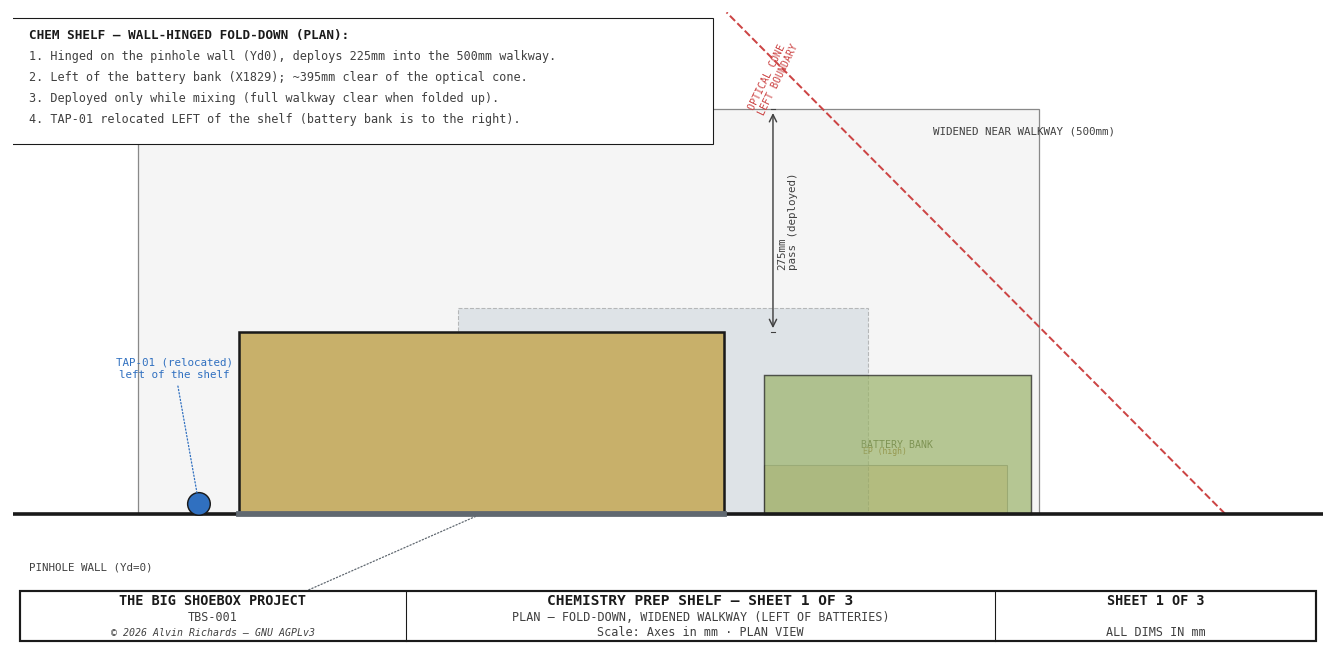
The shelf is in the widened near walkway (500 mm deep), hinged on the pinhole wall left of the battery bank. Deployed, it projects 300 mm into the walkway. The operator stands on the widened walkway and works facing the wall. When folded up, the full walkway is clear.
2.1 Why fold-down (film-plane swing) + optical cone
Film-plane swing. The fold-down removes the conflict with the film plane mechanism: the shelf is only deployed while mixing (film plane parked), and is folded flat against the wall whenever the plane tilts/swings during exposure. No swing restriction is imposed.
Optical cone. Even deployed, the shelf is clear of the optical cone. Its right edge sits left of the cone's left boundary at the shelf's deepest point (Yd=300):
cone_left(300) = PH_X + (FP_X_L − PH_X) × 300 / FP_Y
               = 2,454 + (260 − 2,454) × 300 / 2,262
               = 2,454 − 291 = 2,163 mm
→ the shelf right edge is ~321 mm outside (left of) the cone. No vignetting at any film-plane position.
2.2 Spatial Constraints
| Constraint | Value |
|---|---|
| Deployed footprint | Hinged on the pinhole wall, projects 300 mm |
| Stowed (transport) | Vertical against the wall, ~25 mm proud |
| Work surface height | 945 mm above the 130 mm walkway deck |
| Walkway (widened) | 500 mm deep — ~200 mm pass when deployed, full clear when stowed |
| Evap cooler (stow) | Slides under the deployed shelf |
| Optical cone | ~321 mm clear |
3. Design Specification
3.1 Shelf board
| Parameter | Value |
|---|---|
| Width (X) | 600 mm |
| Depth (Yd, deployed) | 300 mm |
| Work surface height | 945 mm above the walkway deck |
| Thickness | 22 mm (18 mm phenolic ply + 4 mm perimeter frame) |
| Work surface area | 600 × 300 = 0.18 m² |
Work surface: 18 mm phenolic-faced plywood (concrete form ply) — chemical-resistant to cyanotype solutions and pH 3–4 citric acid; smooth, non-absorbent, wipe-clean.
Perimeter frame: 25×25×3 mm mild steel SHS welded into a 600×300 mm rectangle with corner gussets; the ply sits flush inside it. A 15 mm spill-guard lip on the three free edges retains bottles/items. Flat black powder coat.
3.2 Fold-down mechanism
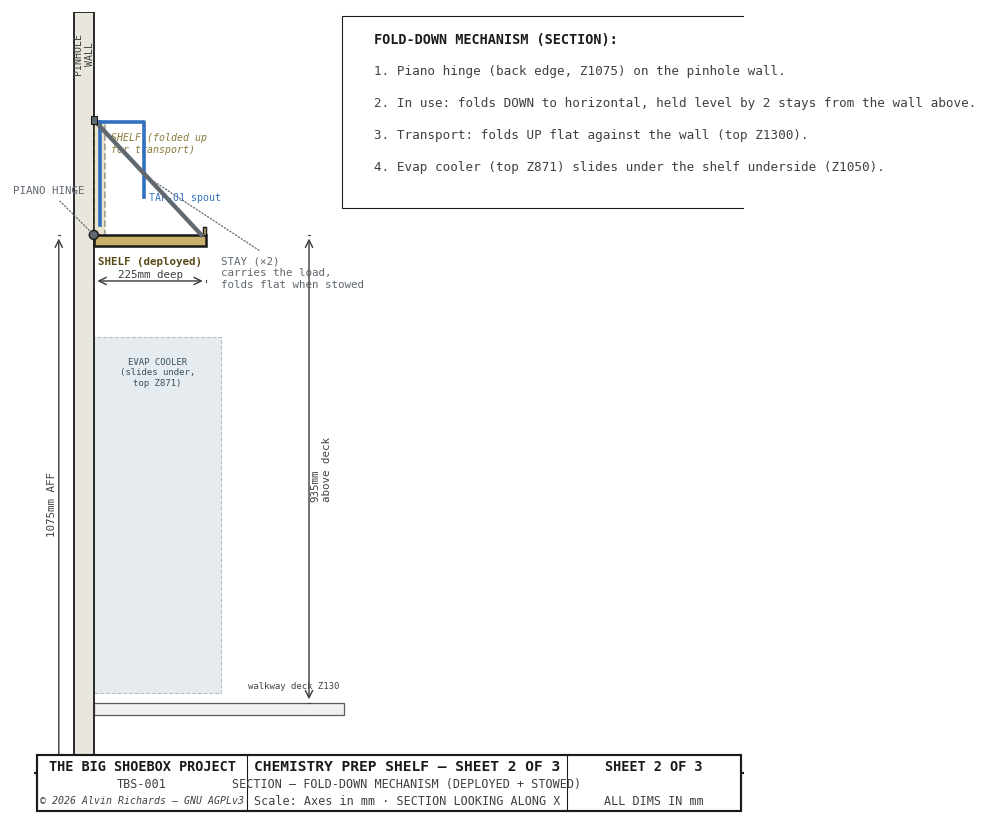
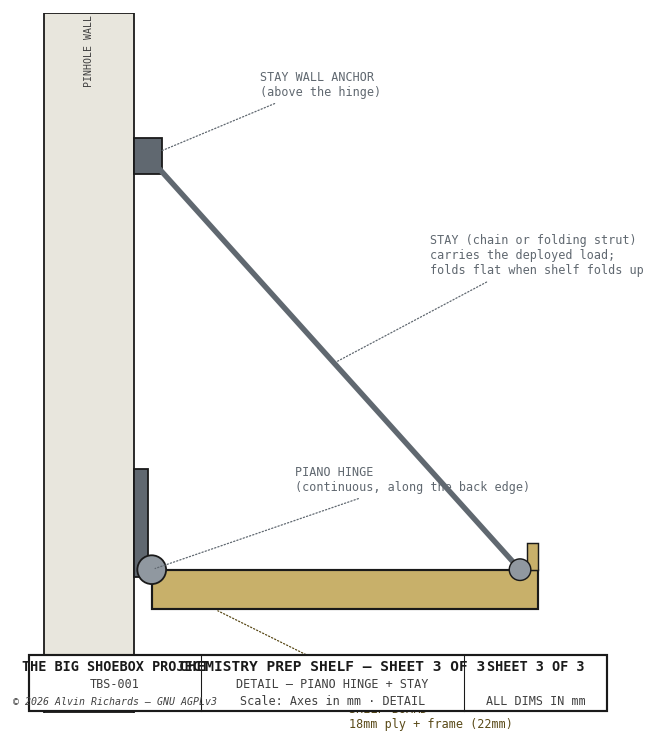
Piano hinge: a continuous steel piano hinge runs the full 600 mm back edge, bolted to a 6 mm mounting cleat on the pinhole wall. Because the pinhole wall is corrugated, the cleat and each stay anchor bolt to flat 8 mm steel backing plates welded to the wall crests (M8×25 into M8 weld-nuts, ~14 mm grip) — flat, solid load anchors rather than bridging the corrugation. The shelf swings between horizontal (deployed) and vertical-up (stowed) about this hinge.
Stays: two stays run from wall anchors ~230 mm above the hinge to the shelf's front corners. Deployed, they hold the board level and carry the shelf + chemistry load; when the shelf folds up they fold flat against the wall. Either a pair of folding fold-flat shelf brackets or diagonal struts/chains may be used — both lock the board level.
Transport latch: a simple over-center latch (or barrel bolt) at the top secures the folded-up board against the wall.
3.3 Load Rating
| Parameter | Value |
|---|---|
| Design load | 25 kg (full bottle, cylinders, roller tray, scale, staging) |
| Carried by | 2 stays + the piano hinge (hinge reacts the back edge) |
| Load per stay | ~12.5 kg + shelf self-weight share — well within a folding bracket's rating (typ. 30–50 kg each) |
| Hinge | Continuous piano hinge along 600 mm — distributes the back-edge reaction |
The fold-down hardware is comfortably rated for the light mixing load.
3.4 Leveling
Slotted holes in the stay wall anchors (or adjustable folding brackets) give ±5 mm at each front corner; level the board with a spirit level on first install, then lock.
4. Transport Mode
The shelf folds UP flat against the pinhole wall and latches.
| Check | Status |
|---|---|
| Walkway clearance | Folded up, ~25 mm proud of the wall — full walkway clear ✓ |
| Film-plane clearance | Folded flat — never in the swing envelope ✓ |
| Overhead clearance | 425mm below the cable trunking ✓ |
| Evap stow | Evap tucks below the folded board ✓ |
| Vibration | Board latched flat against the wall; no loose span ✓ |
5. Operator Access
The operator stands on the widened near walkway at about the shelf midpoint, facing the wall. The deployed surface (945 mm above the deck) is ergonomic counter height; the full depth is reachable. The tap (left of the shelf) fills containers staged on the board.
When deployed, the 300 mm board leaves ~200 mm of the 500 mm walkway behind it — enough for the operator to work but not for through-traffic; this is acceptable because the shelf is only down while mixing. Folded up, the walkway is fully clear in both directions.
6. Assembly Sequence
- Fabricate the shelf frame: weld a 25×25×3 mm SHS 600×300 mm rectangle with corner gussets.
- Weld the 15 mm spill-guard lip to the three free edges; weld the transport-latch keeper.
- Insert the 18 mm phenolic ply panel; secure with M5 CSK screws from the frame underside.
- Bolt the wall mounting cleat to the pinhole wall at Z=1075 (X=1180–1780), into the ribs/backing.
- Bolt the continuous piano hinge to the cleat and to the shelf back edge.
- Fit the two stay wall anchors ~230 mm above the hinge (slotted for leveling).
- Fit the two stays (folding brackets or struts) to the anchors and the shelf front corners.
- Deploy, level with a spirit level, lock the stay adjustment.
- Fit the transport latch; verify the board folds up flat and latches clear of the wall equipment.
- Verify: deployed level + rigid under load; folded-up clear of the evap stow and walkway.
7. Parts List
| Item | Spec | Qty | Supplier | Est. cost |
|---|---|---|---|---|
| UV-coated white plywood (work surface) (BPI6WUV2I) | Swaner 18mm × 4'×8' UV-coated white hardwood ply (1220×2440mm), cut to 300×600. UV-coated face gives a sealed, wipeable work surface — substitute for the phenolic concrete-form sheet (same purpose, readily stocked). | 1 4'×8' 18mm sheet | Home Depot | $73 |
| 25×25×3 mm steel SHS | 6 m (frame + spill lip) | 1 lot | Online Metals / Metal Supermarkets | $30 |
| Continuous (piano) hinge, 600 mm (LSN8-32-600) | Weld-on continuous piano hinge, 1-1/4" open width (32 mm) × 23-5/8" (600 mm) long, stainless/steel | 1 ea | Wurth Baer Supply | $24 |
| Folding shelf stays/brackets, zinc | Zinc-plated steel folding shelf bracket (fold-flat, ~30–50 kg rating); qty 2 = 1 pair. Zinc chosen over stainless — mounting is dry/hidden, not splash-facing (Alvin 2026-08-01). ~$12 ea est; firm SKU + price at purchase. | 2 ea | Amazon / McMaster-Carr | $24 |
| Wall mounting cleat + anchors | 6 mm steel cleat + 2 stay anchors (slotted) | 1 lot | Local fab | $18 |
| Shelf mount backing plates, 8mm steel (welded, ×3) | Flat 8mm steel backing plates welded to the pinhole-wall interior crests — one behind the hinge cleat + one per stay anchor — giving flat, solid load anchors with M8 weld-nuts. | 3 ea | Local fab | $18–$30 |
| M8×1.25 × 25 hex bolt, Grade 8.8 zinc — shelf cleat + stay mount (91280A534) | Clamps the shelf hinge cleat (6mm) + 2 stay anchors to their welded 8mm backing plates (M8 weld-nut). Grip ≈ 14mm → M8×25. Pitch M8×1.25 coarse. $18.51/pack of 50 (same 91280A534 as the film ICP-14 fixing). | 12 ea | McMaster-Carr | $4 |
| M8×1.25 hex nut, plain SS (90591A161) | Plain hex nut — shelf wall bolts. Pitch M8×1.25 coarse — confirmed vs 90591A161 PDF 2026-07-29 (matches the bolt). $7.53/pack of 100. | 12 ea | McMaster-Carr | $1 |
| M8 flat washer, SS (91166A270) | Flat washer (1/bolt) — shelf wall bolts. $3.32/pack of 100. | 12 ea | McMaster-Carr | $0 |
| Transport latch (over-center/barrel), zinc | Zinc over-center draw/toggle latch — secures the folded board for transport. Zinc (dry/hidden, not splash-facing — Alvin 2026-08-01). ~$8 est; firm SKU + price at purchase. | 1 ea | Amazon | $8 |
| M5×16 countersunk screw, A2-70 SS (91420A326) | Ply panel attachment (same M5×16 CSK as the clamp clips — 91420A326) | 8 ea | McMaster-Carr | $1 |
| Corner gusset plate, 3 mm | 50×50 mm triangular | 4 ea | Steel offcut | $5 |
| Flat black epoxy spray paint | frame + hardware finish | 1 can | Hardware store | $12 |
| ½" PVC Sch-40 pipe (tap relocation) (30-05010HD) | Extend the blue supply trunk ~1.3 m left to TAP-01 (PVC Sch-40, per the joint convention). IPEX ½" × 10 ft — same stick as pvc-half; one covers the run. | 1 stick | Home Depot | $5 |
| Shelf total | $223–$235 |
The relocated TAP-01 + BV-06 hardware itself is unchanged (carried in the water-system BOM); only the ~1.3 m trunk extension is added here.
8. Maintenance
| Interval | Task |
|---|---|
| Before each session | Deploy + check level; wipe the surface; inspect the spill lip for residue |
| Before each session | Confirm the stays lock positively and the hinge swings freely |
| Monthly | Inspect the hinge, stays, and wall bolts for corrosion/tightness |
| Before transport | Fold up + latch; confirm clear of the evap stow and walkway |
| After transport | Re-deploy and re-check level |
9. Source References
- ISO 668:2020 — Series 1 freight containers: dimensions and ratings.
- Walkway System Report — Walkway deck height and the widened near-walkway section.
- Equipment Layout Report — Optical cone clearance and pinhole-wall zone definitions.